
Are Neanderthals uncanny?
kinda, yeah
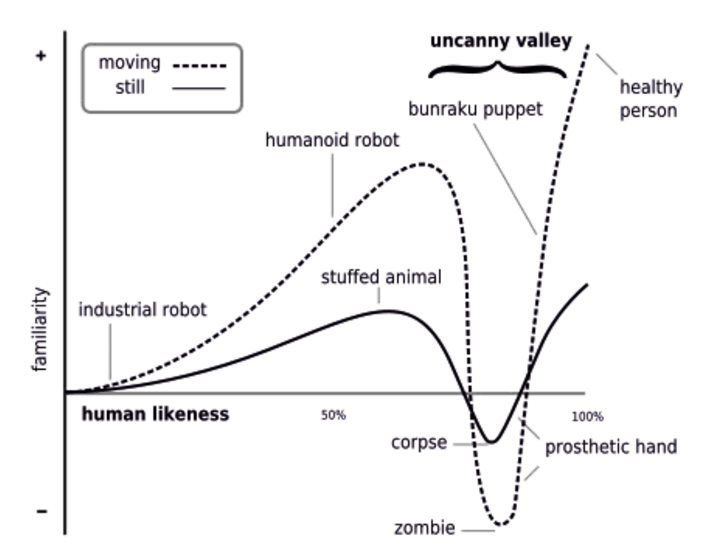
You have presumably heard of the uncanny valley. Very simply, it proposes that we linearly like things that look like human beings, up to a specific point where they look like people but not quite, and then we really hate them a lot. If you trust Freud, this is because something something castration.
Recently I tweeted this offhand joke:
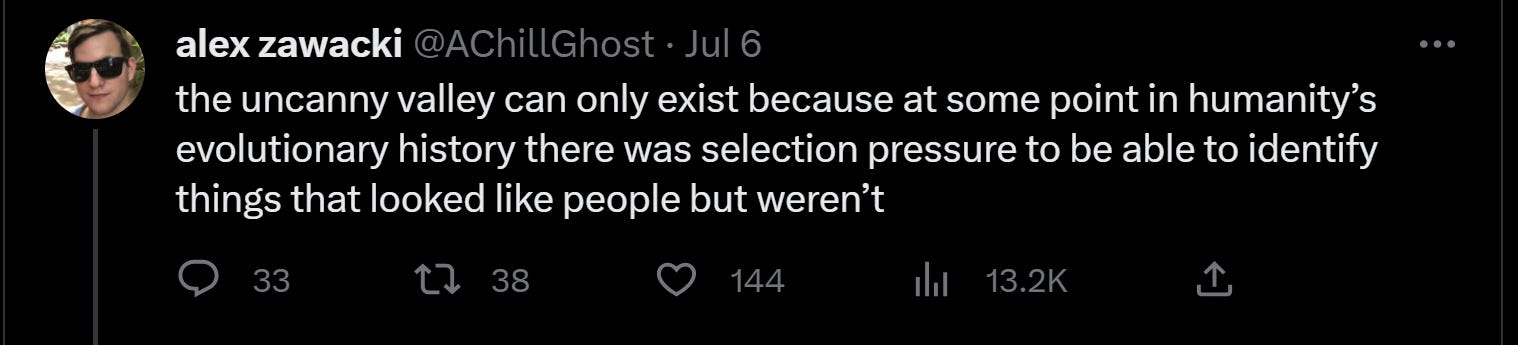
Aside from the people calling me a moron, the responses generally clustered around three themes:
This is because of the Nephilim
This is because of corpses
This is because of Neanderthals and other hominids
#1 is obviously correct, #2 is on pretty solid ground, but #3 is curious. Could the uncanny valley have evolved as a response to run-ins with other hominids?
This post will not in any way be a serious attempt at evolutionary psychology, which as a whole is some unclear mixture of real and fake. Still, I’ve previously written scientific (taking the word in the loosest possible sense) explorations of how to kill a ghost and how many vampires are living in contemporary America, and this is at least less weird than that, so let’s run with it. Could competition with Neanderthals have produced the uncanny valley effect?
Probably not. For one thing, monkeys experience it, so it was likely already bred into anatomically modern humans by the time we appeared on the scene. For another, while humans migrating out of Africa ran into (and sometimes slept with) Neanderthals, sub-Saharan Africans wouldn’t have, since our stockier cousins evolved in Eurasia and don’t seem to have crossed the Mediterranean.
Two objections present themselves: first, the migration out of Africa was not a one way trip or a one time thing; groups of humans repeatedly crossed back into the continent after their ancestors had departed. It’s possible, if not likely because of the monkey thing, that they developed whatever specific gene codes for “not liking things that kind of look like people but aren’t” in Eurasia and then brought it back to the homeland, where it diffused across the sub-Saharan population. Second, and more cogently, there were probably other hominids kicking around Africa for a while. Some groups in West Africa seem to have interbred with an unknown species of archaic hominid around 50,000 years ago. So, the objection might run, we could easily have learned uncanniness from whatever those things were, long before anyone left Africa.
Again, the monkey thing protests, but another issue with hypothesizing that the uncanny valley is an evolved response to other hominids is that we kept sleeping with them. Like, repeatedly: at least “once with Neanderthals, and twice with the Denisovans,” leaving aside the introgression of hominid DNA in those West African populations I’d mentioned.
It is of course possible that Neanderthals could be unsettling and repulsive and yet people would still occasionally hook up with them. We have all been on the internet. Fortunately, we can test at least one half of this hypothesis (in fact we can test both halves but I’m not going to do that). So, are Neanderthals uncanny?
I ran a survey to find out. This is of course not science. I controlled for absolutely nothing, my sample size is 39, and I am doing no statistics on the results whatsoever. If you’d like to take my data and run a linear regression or a paired t-test or whatever, let me know, but I don’t get paid enough.
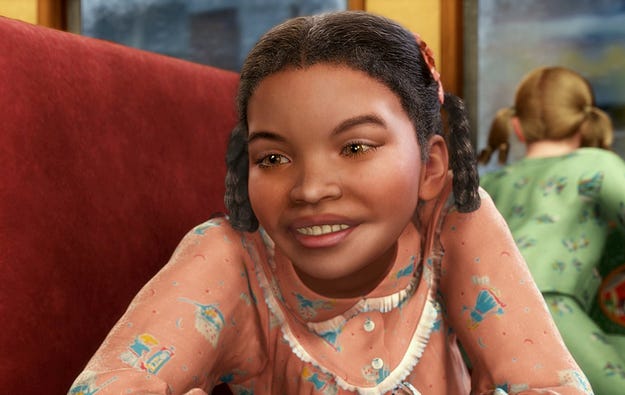
The survey’s simple. I presented 13 photos: a toy robot, a bunraku puppet, two reconstructions of a Neanderthal (one in which he’s wearing a smart suit), a grey alien, a zombie, the dead body from Stand By Me, a prosthetic hand, Jasom Momoa, one of the kids from Polar Express, an industrial robot, a humanoid robot, and Mariya Takeuchi. I asked everyone to rate each thing on a positivity scale from 1 (“hate that”) to 10 (“love it”). Here’s what I got:
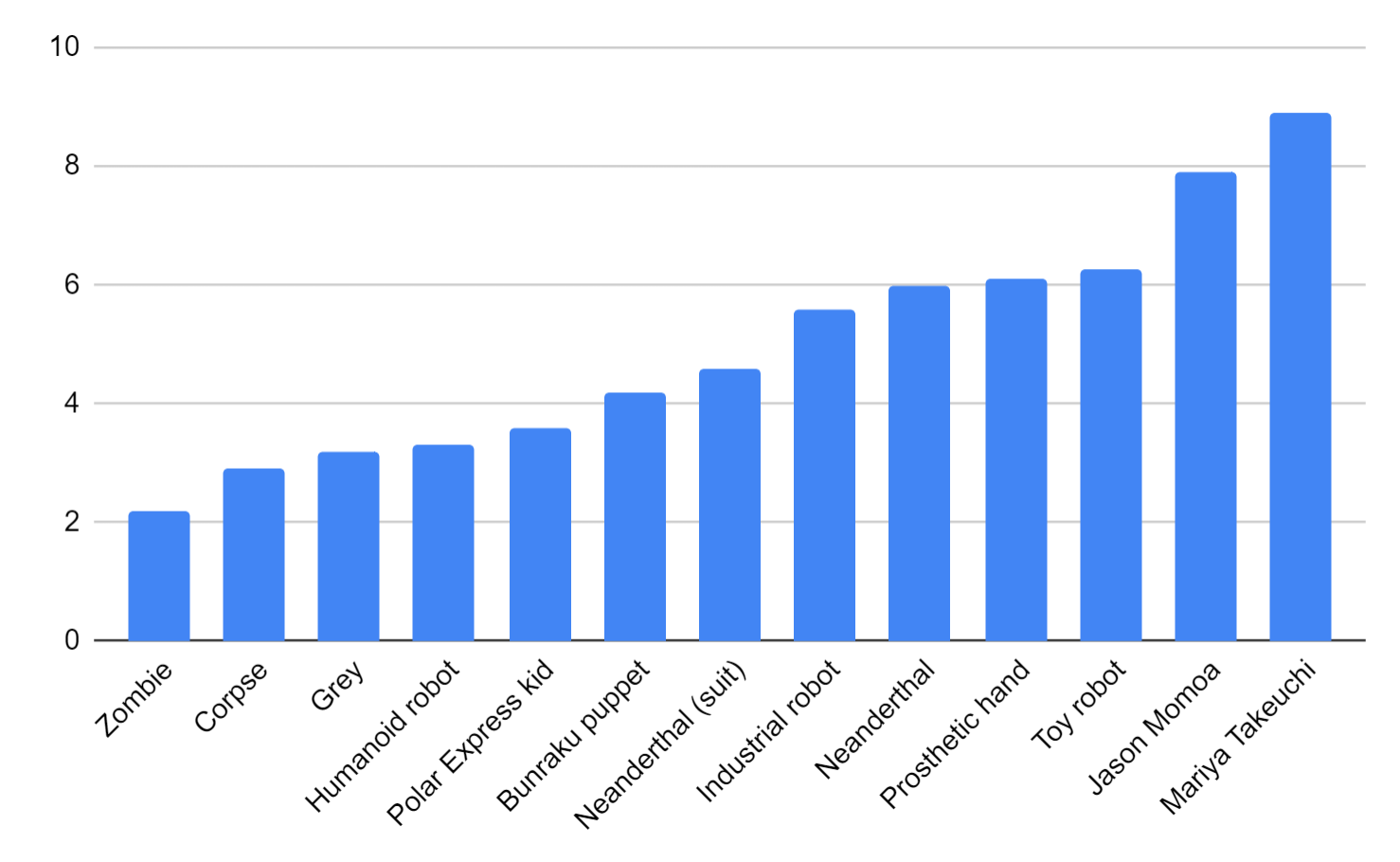
I did not expect my results to match up with the original graph, both because of my small sample size and because (as Dot Porter pointed out on Twitter) that graph was not based on actual social science research but rather vibes. There is a fair bit of actual science on the uncanny valley, which does indicate that it’s a real thing, although none of those results realy map to Mori’s graph either, because his x-axis representating similar to human beings is kind of made up. There are no numbers; it’s just how similar the author thought each thing was to a human being. Is a prosthetic hand really more similar to a human than a corpse? Is a bunraku puppet? Too subjective. I decided to forgo an x-axis and just list the positivity.
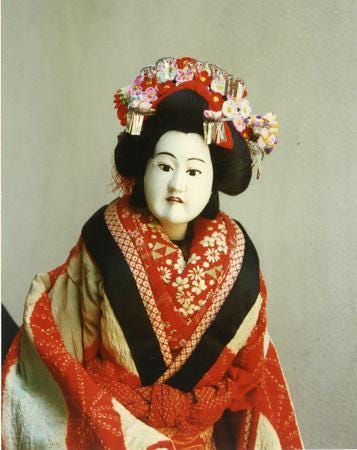
The question of similarity aside, the positivity results are roughly in line with Mori’s. Toy robot is in the middle. Ms. Takeuchi topped the list with the highest positivity and the least variance, followed closely by Jason Momoa. This is expected; they are both healthy and attractive humans, and should evoke the highest positive valence. Also, probably most of the people who took my survey are dudes. The zombie was the most negative — which matches up with Mori’s estimates— beating out the corpse, although admittedly I used a grosser picture of a zombie than I did of a corpse. Grey alien came in third worst after those two. Contra Mori, no one liked the bunraku puppet, which may be a cultural artifact as I assume most of my responders are western and I don’t really know what a bunraku puppet is.
Anyway, I asked about Neanderthals. But I couldn’t just ask whether or not people liked Neanderthals, because — in the absence of a meaningful x-axis — a negative answer wouldn’t mean they were uncanny, it would just mean people didn’t like Neanderthals. So I used two pictures of a Neanderthal, and everyone hated one of them a lot more than the other.
Here’s one:
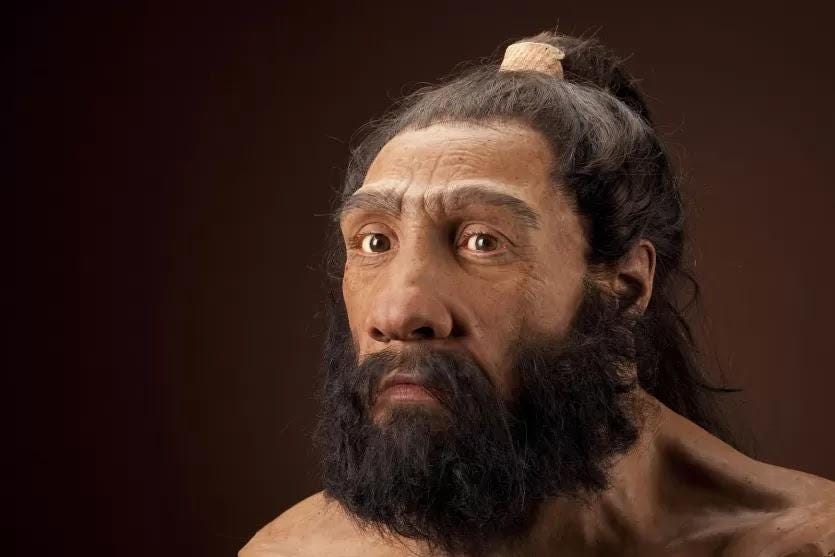
And here’s the other:
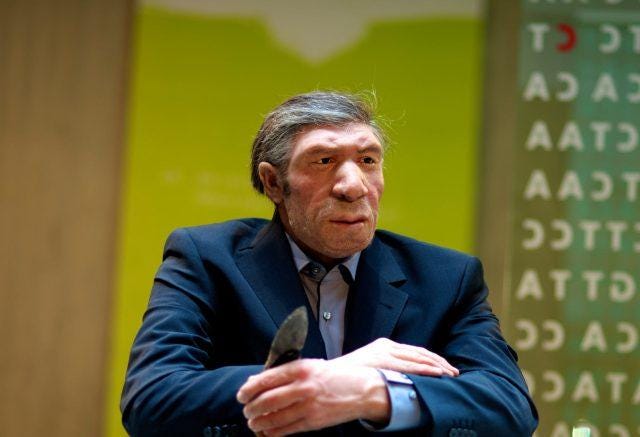
The “regular” Neanderthal came out at an average positivity rating of 6. That’s above the middle! For context, the prosthetic hand and the toy robot were 6.1 and 6.25, respectively. People liked the Neanderthal only slightly less than the toy robot and a lot more than the kid from Polar Express (3.6). But what’s more interesting is that everyone hated the Neanderthal in a suit. He came out at 4.6, significantly below his nuder, hairier brother. Yes, their faces are different, but the biggest dissimilarities are the hairstyle and the suit, both of which serve to make the Neanderthal look more like a contemporary human. That something that looks more-human-but-still-not-quite would get lower positivity ratings than something that looks a lot less human would support placing Neanderthals in the uncanny valley.
A better way of doing this would have been to ask people to rate both their positive feelings towards each picture and how human they thought it looked. Oops. Next time.