
Ghosts on the Road
The Middle Ages knew very little of haunted houses. The ancients did, a little bit; Pliny writes of a house in Athens troubled by the specter of a filthy old man wrapped in chains, which in consequence was all but abandoned for lack of tenants. Less so the medievals, who knew instead about haunted people. For most of the period roughly spanning the fall of Rome and the day Richard III took a halberd to the skull, ghosts generally didn’t linger around the decayed manor at the edge of the village, burned in the border skirmishes and sinking now into the Yorkshire moors; they haunted you. Your dead lover, your apostate brother, the child your wife aborted: these things appeared to you at midnight or at noon, midnight’s polarity. There were exceptions — there are always exceptions — but stranger ghosts, the dead to whom you were not bound by ties of kinship or society or guilt, rarely troubled you. Your ghosts were your own.
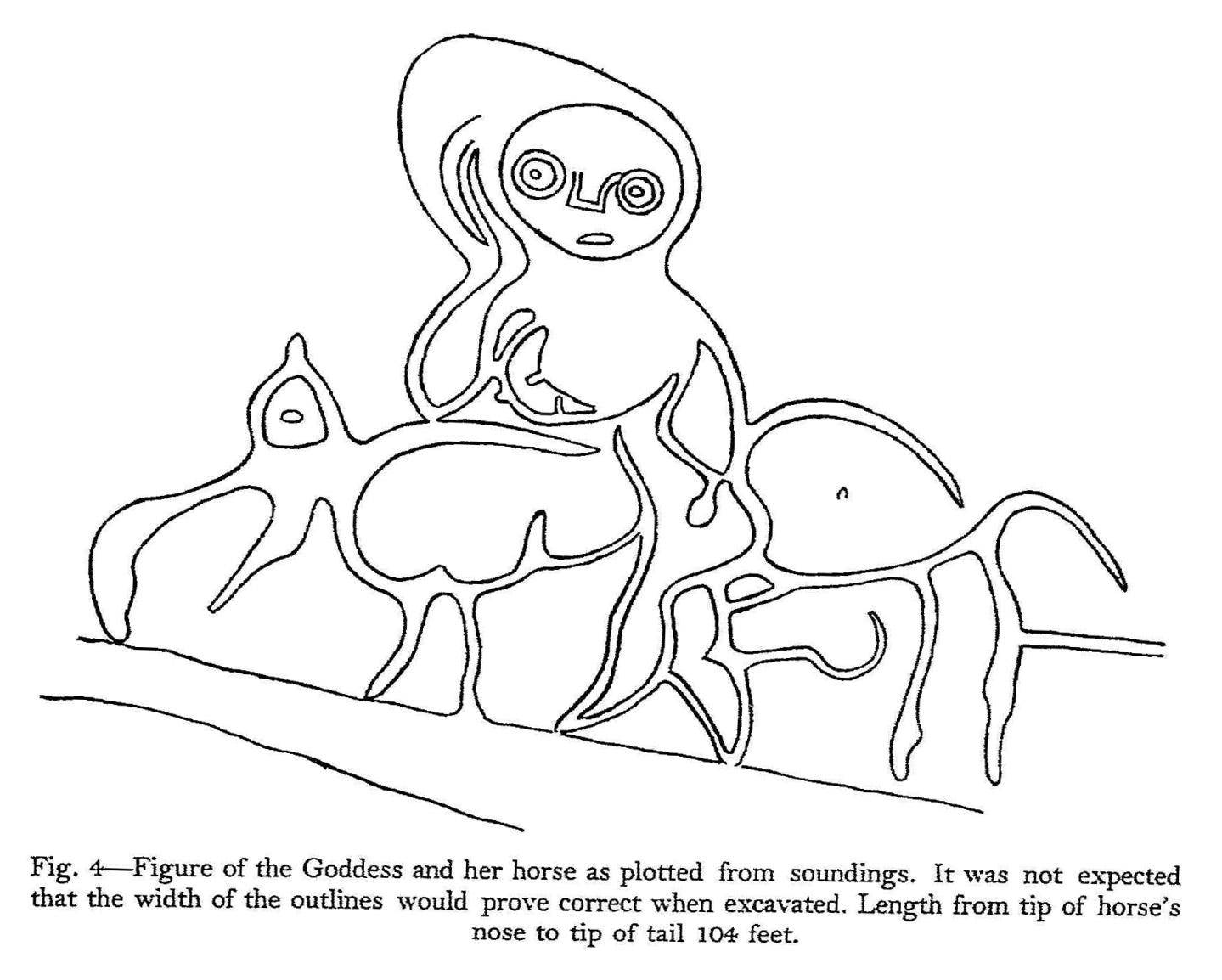
Ghosts did not haunt houses, but they might haunt the landscape. Not far from Cambridge sits the Iron Age hillfort of Wandlebury, a great circle of earth and (once) wooden ramparts. Its soil is full of skeletons, most of them mutilated by war or ritual or execration. A six-year-old child with its legs severed, sewn into a sack with a bronze needle. A woman, decapitated, her legs shattered. A dog’s torso, alone in a pit. Around the old Celtic hill sit the Gogmagog hills, named for a warrior-giant; until the 19th century or so you could see the monster himself, carved into the turf of the hillside and outlined by the white chalk beneath — one of Britain’s variously enigmatic hill figures, only one of which is plausibly prehistoric. It’s lost now; we only know about it from a few 17th century antiquaries, and we don’t really know what it looked like or even where exactly it was. Once, though, a scholar thought he’d found it by wandering over the terrain and poking thin rods into the earth, tracing the depth of the chalk below and carefully carving away the turf according to his calculations. When his colleagues ridiculed his methods and the strange witch-figure he’d uncovered, he went into exile on the Cornish peninsula and devoted himself to ghosthunting. There were, he decided, spirits encoded in wood and stone; with the right tools they might be coaxed out, history made to replay itself in hologram.
Wandlebury is the kind of place that ought to be haunted, and it was. Gervase of Tilbury, writing in the early 13th century, knew about Wandlebury; he thought the name came from the Wandali, or Vandals, which it doesn’t, but he knew it was a fort surrounded by earthworks. He doesn’t say anything about the hill figure, which might support the 17th century writer who indicated that it was a fairly recent addition by bored Cambridge students, but nevermind. There was, Gervase said, an ancient story that if a knight, alone, entered the ring in “the silence of night” and called out a challenge — “Let a knight come out against a knight!” — then an armed figure would appear on the far side and proffer violence. One winter’s eve, a visiting knight named Osbert heard the story around the fireside in a nearby castle and could not be restrained from riding out to test its veracity. He rode to the fort alone save his squire, whom he left beyond the earthworks. When he called out for his opponent, a knight — “or something in the semblance of a knight” — appeared and rode towards him with shield down and lance fewetered. (Great word, “fewtered”). When the dark figure of the hillfort was overthrown in the battle that followed he disappeared — but not his horse, which Osbert captured took as spoils and proof of his victory. All black it was, mane and trappings and saddle; at cockcrow it burst its reins and vanished into the predawn gloaming. Osbert, disarming, found he’d received a wound through the thigh, the blood already clotting by the time he was stripped of his greaves. There was something wrong with the injury: each year, on the anniversary of his fight with the dweller at the fort, the wound broke open and bled anew.1 Still, he lived happily after after until he died on crusade.
The wild spirits of the Middle Ages are troublesome things. Some of them fit neatly into the framework I outlined above; Peter the Venerable recounts the tale of a steward who, passing through a wood at midday, met the spirit of a rapacious local landowner who plead with him to intervene on his behalf with the abbot of nearby Cluny in order that his soul might find relief from its purgatorial sufferings. This is the kind of story that medieval clerics adored, and for obvious reasons: it reminds the aquisitive secular lords that their power is limited to this world, that there are consequences for their sins, and that the Church they persecute in this life is the only thing that can help them in the next. As stories, these had didactic value: they enforced moral norms (in this case, “don’t lead armed sallies against your neighbors”) and upheld the spiritual authority of priests and bishops and abbots. But many of them are much weirder than this. What is the moral of Gervase’s story? What was that figure on the hillfort- a spirit, a demon, or something else? There were, sometimes, things on the roads and in the trees. The medievals kept good records of miracles at their shrines and holy places, and these are full of accounts of people seeking cures after having suddenly fallen ill — being blinded, or crippled, or on at least a few occasions filled bodily with lizards — while out of doors. At least one scholar has suggested that these curiously sourceless illnesses are instances of quiet clerical censorship, and that behind them lay stories of people being assailed by the kinds of entities that don’t fit nearly into a divine/demonic heuristic.
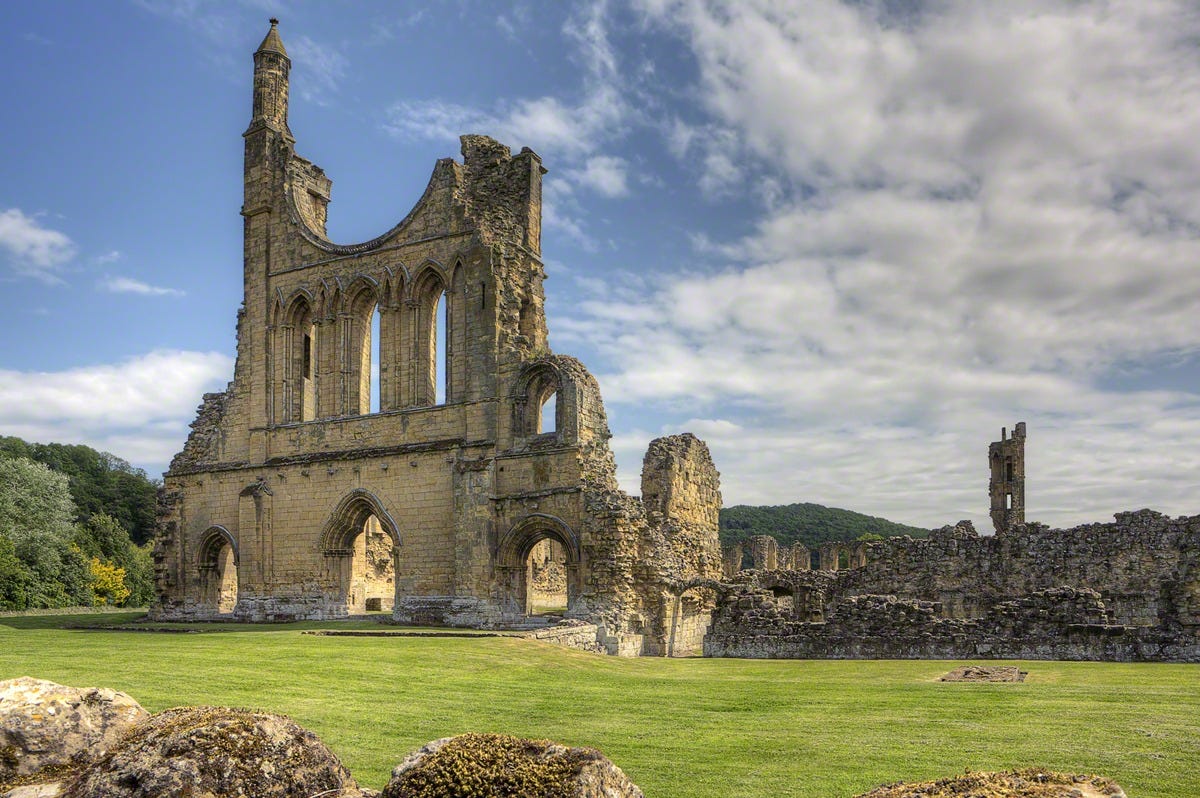
Most medieval ghost stories are not very frightening, and many aren’t even especially interesting. Lots take the general form of Peter the Venerable’s be-good-or-else exemplum. Not so the stories of the anonymous Monk of Byland, who at some point around 1400 scribbled twelve ghost stories in spare leaves of what is now the British Library’s Royal MS 15, A.XX. These stories are noteworthy for being extremely, extremely weird. Take the first one, in which a man is out on horseback carrying beans somewhere when he runs into a horse standing on its hind legs. The man forbids the weird horse in the name of Christ from doing him harm. It walks with him for awhile (presumably back on all fours) before transforming into “a revolving haycock with a light in the middle,” which doesn’t really make any sense. Now the bean man “conjures” it — not really a term we have any longer; we tend to think of “conjuring” as synonymous with “summoning. In medieval accounts of the supernatural to “conjure” something generally means to talk to you. The weird glowing hay pile assumes the figure of a man and asks to help carry the beans, which he does as far as a stream that he cannot cross. No further conversation is reported between the man and the spirit, but the former has masses said for the latter anyway on the assumption that he’s some sort of suffering soul.
Most of these ghosts do still need help; “unfinished business” in medieval ghost stories generally takes the form of “unattoned sins,” which could be alleviated by the prayers and masses of the living. A man named William of Bradeforth is three times followed by a spirit on the road that says nothing but cries “how, how, how” — ghosts, in both Classical and medieval ghost stories, tend to be inarticulate until conjured, making terrible noises but incapable of speech. But William doesn’t conjure him; he orders it in Christ’s name to go away, which it does "in the form of “a revolving piece of canvas with four corners and kept on turning.” The narrator seems concerned by this; it seems, he writes, “that he was a ghost that mightiliy desired to be conjured and to receive effective help.” Some of the dead, though, seem strictly evil. A certain James Tankerlay, a priest (rector) in life, rose from the dead after his burial and wandered the roads by night. He did not help anyone carrying beans, but he did “blow out” the eyeball of his (still living) concubine. His body is exhumed and thrown into a lake.
And some of the spirits are just strange. A certain woman, it is said, “laid hold of a ghost and carried him on her back into a certain home in presence of some men, one of whom reported that he saw the hands of the woman sink deeply into the felsh of the ghost as though the flesh were rotten and not solid but phantom flesh.” The story ends here, giving us no idea who the spirit was or why a woman was carrying it around on her back. There’s a much earlier Irish tale, the Echtra Nerai, in which a man takes down a speaking corpse from the gallows (on Samhain, no less) and carries it around on his back for a while; maybe something like that?
There is very little else like these stories in the medieval corpus. Many of them have little or no clear moral or didactic message. In them the Church certainly has power over the dead, but reinforcing that idea can’t have been his only intention or else he wouldn’t have been lead down weirder paths like the soft rubbery ghost. And even stories that explicitly stress the ability of the living to help the dead are full of surreal details like the flapping, rotating canvas. Parallels to inexplicable, even inorganic ghosts like this one can be found in the writings of Edmund Jones, an 18th century minister.2 There, again, they’re met in the lonely places: fields and fens and the edges of becks, lonely crossroads and lanes banked by hedges. Jones was a Welsh Calvinist; three full centuries, half an island, and a Reformation divided him from the anonymous monk in Byland Abbey. It was an entirely different world. But the landscape was still haunted. There were still things out there. There probably still are.
Medieval accounts like this one are where Tolkien got the bits about Frodo suffering each year on the anniversaries of his woundings by the Ringwraiths and Shelob, incidentally.
Now published under the title The Appearance of Evil: Apparitions of Spirits in Wales (2004).